Showing posts with label trippy transportation. Show all posts

Friday, February 3, 2012

GM's "New Look" Bus

GM's "New Look" Bus
In 1959, General Motors introduced its iconic "New Look" transit bus.

With its slanted windows, fluted aluminum siding and distinctive 6-piece rounded windshield, the design quickly became known as the "Fishbowl".

The original production began in late 1959 in Pontiac, Michigan, and the very first New Looks were delivered to the Washington, D.C. transit system that same year. In 1961, a second production line was started in London, Ontario, with their first buses going to the Hull City Transport in Hull, Quebec. US production ended in 1977 but continued in Canada until 1986. More than 44,000 units were built throughout this time.

The buses were produced in several lengths: 29, 35 and 40 feet. Transmission choices were four-speed manual or automatic. Originally, all New Looks were powered by 6-cylinder diesel engines. General Motors resisted V8 power but eventually gave in to pressure from customers.

New Looks were available in both "Transit" and "Suburban" versions. Transits were traditional city buses with two doors; Suburbans had high-backed, forward-facing seats, underfloor luggage bays, and only one door. GM had refused to install lavatories on its buses, so some transit companies added their own...!

GM's "New Look" Bus
The New Look's reliability, ease of maintenance and relatively economical operation made it the mainstay of North American transit systems from the 1960's through to the 80's.

Bus drivers loved them because of the ease of steering and the visibility through the large windows. Bus enthusiasts call it their favorite.

I've always loved the New Look's design: there's something about the windswept windows, the fishbowl windshield, the angles that keep it from looking too "boxy"... It's what I picture in my mind when I think of a "bus".

GM's "New Look" Bus 
images: stevemunro.ca, scanned from a 1963 brochure.

Saturday, November 6, 2010

Inside the Expo-Express

Each Expo Express train could shuttle up to 1000 Expo 67 visitors at a time.

Check out these ultra-rare shots of the Expo Express at Expo 67, North America's first fully automated rapid transit system.

To avoid visitor uneasiness, operators from Montreal's transit union were placed at the front of the train to give the illusion that they were conducting the self-sufficient Expo Express. Operators performed mundane tasks, such as opening and closing the doors of the train, to reduce boredom.

According to Wikipedia, there was a minor incident involving an Expo Express operator during Expo 67... at the La Ronde station:

"The conductor had pressed the button to close the doors and proceed, but his train had already sensed an oncoming express from Île-Notre-Dame and automatically delayed the go command to let it roll in. In the meantime, the driver realized he had forgotten his lunch. However, he could not exit though the passenger doors because his train was in a "wait" state and would not allow the doors to open. Instead, he crawled through the small cab window. By the time he had fetched his lunch, however, the oncoming train had pulled in and his train had taken off on its own. It crossed the bridge over the Le Moyne Channel, proceeded along the seaway, and came to a smooth stop at Île-Notre-Dame station where an Expo official was waiting. This person crawled back through the cab window and pressed the button to open the doors and let the passengers disembark."


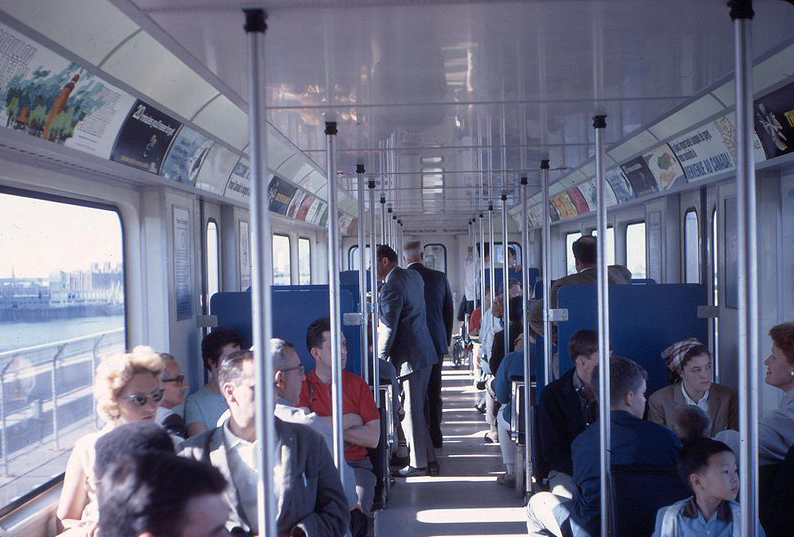
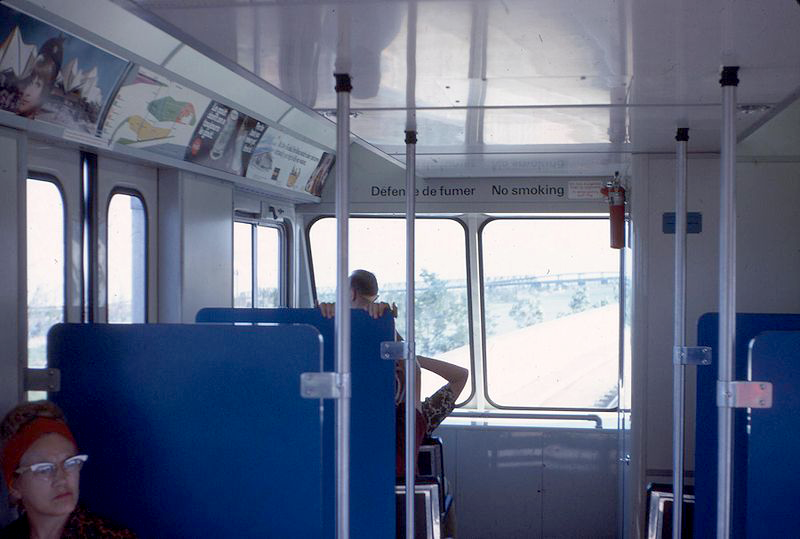
The interior of Expo Express, looking towards the front.

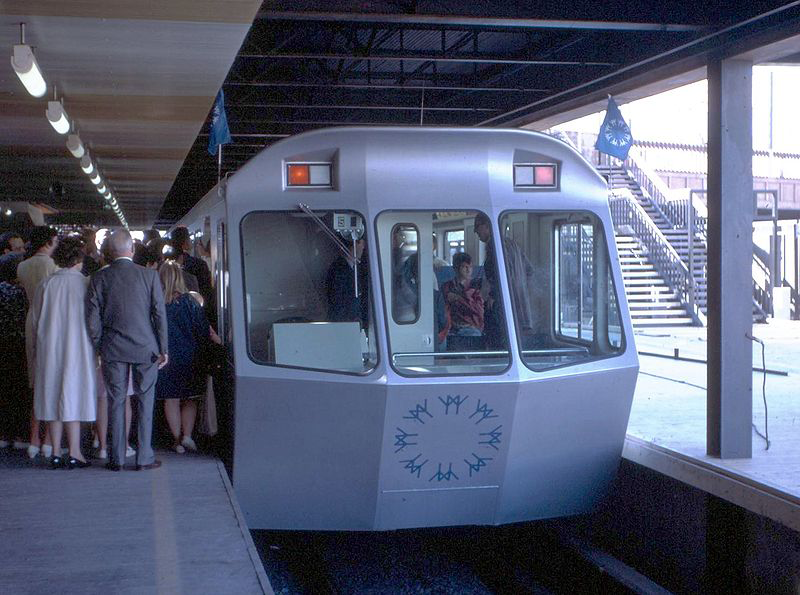
A front view of the train at Place d'Accueil terminal.

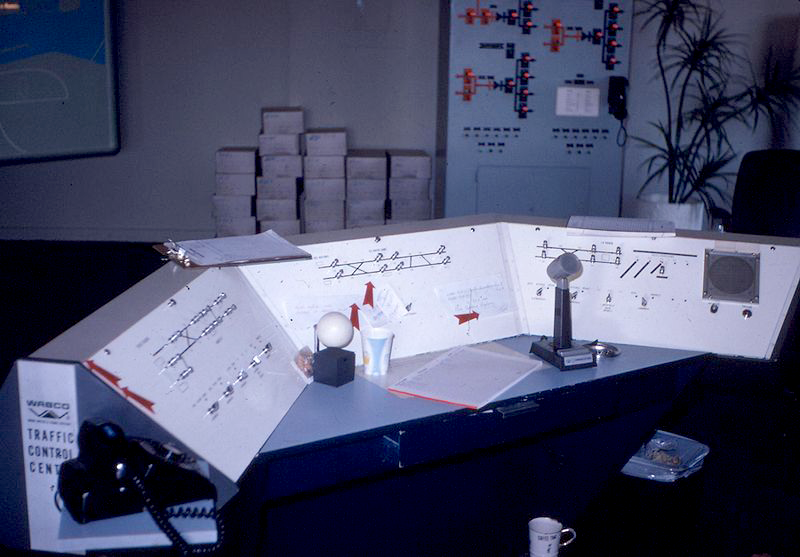
The system's control console seemed straight out of Star Trek... Beam me up!


images: wikipedia.org

Saturday, April 3, 2010

Expo 67 Monorail Garage

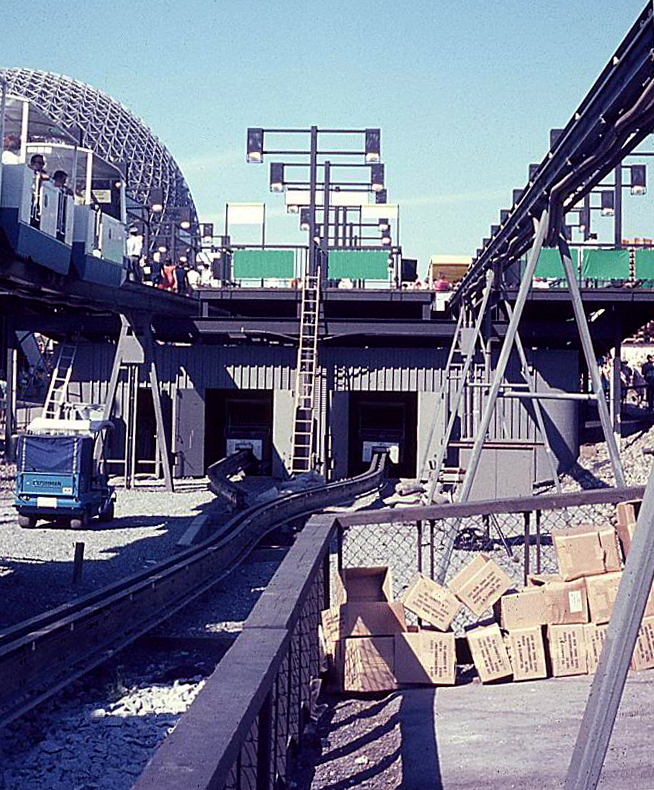
Check out this rare shot of an Expo Monorail garage under the embarkment platform of one of the stations... I wonder what was in the cardboard boxes?

image sourced from ebay.com

Sunday, February 3, 2008

Magic Highway USA, 1958


This is just the type of atomic-era, retro-futuristic document I love.

An exerpt from a 1958 Disneyland TV show, these animated predictions on future transportation technologies look very Jetsons-esque...

Sunday, January 27, 2008

The Sky Ride

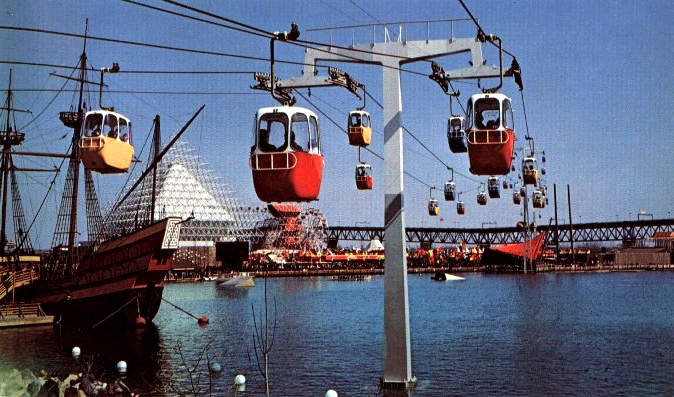
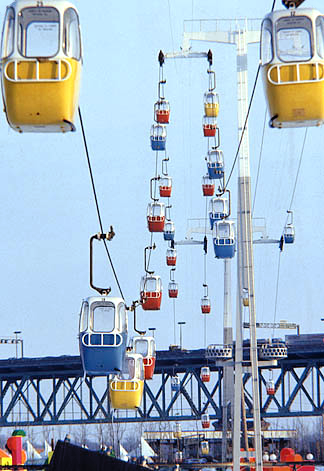
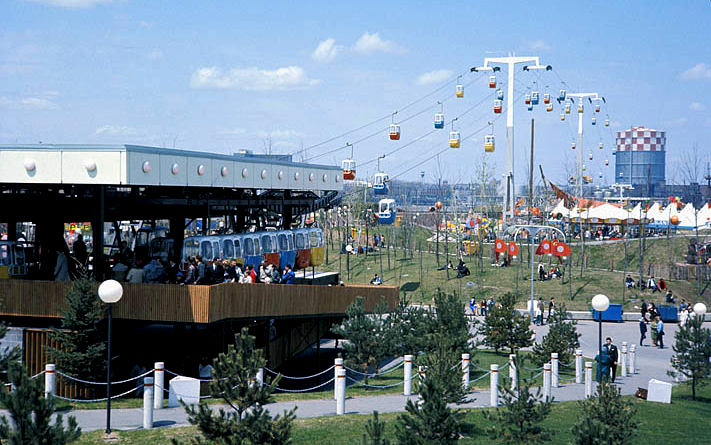
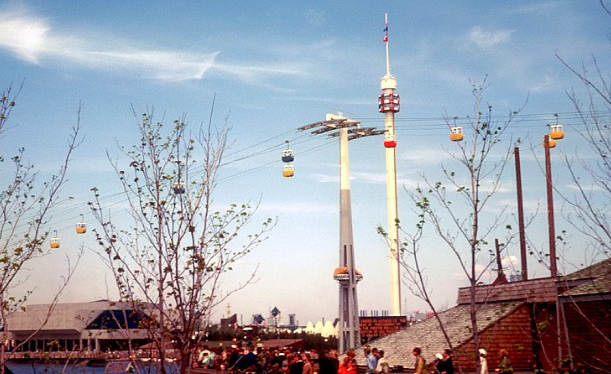
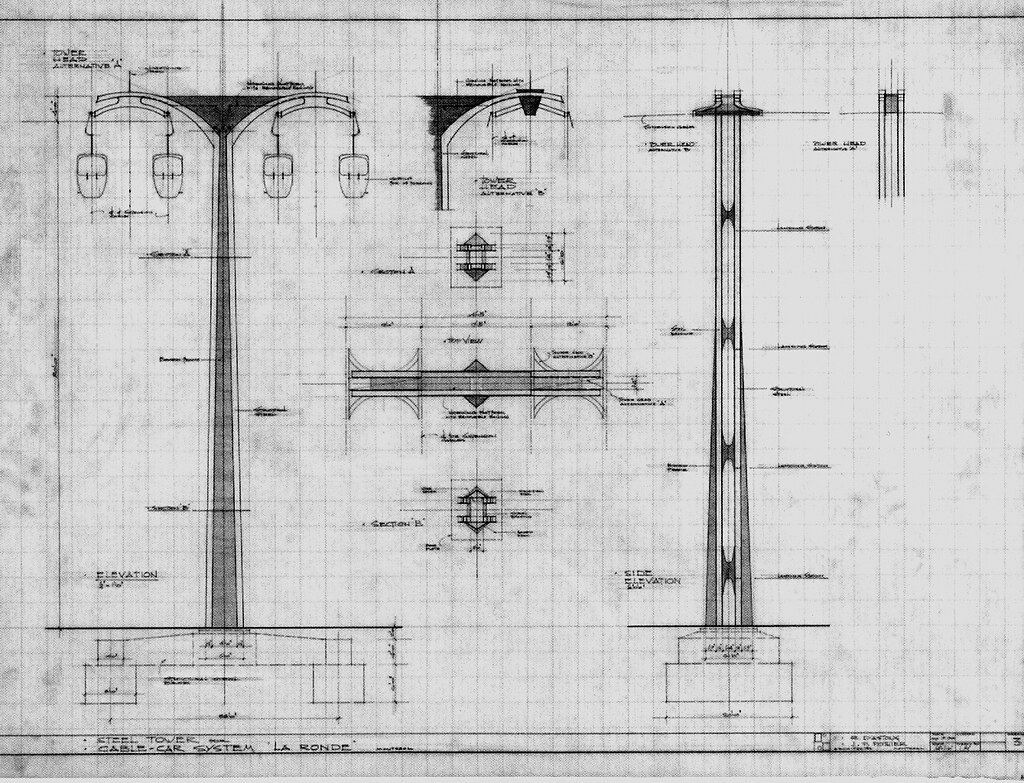
The Sky Ride was a 120-foot high cable car system that travelled over Dolphin Lake in the La Ronde sector of Expo 67.

Brightly colored gondolas holding 4 persons each carried passengers from the Expo Express station (at La Ronde's entrance) to another station in Le Village, an old-style Québecois village located at the opposite end of the park.

The cable cars offered visitors a panoramic view of the site, as well as the Montreal skyline, but bird's eye views were just one of the ride's functions: the Sky Ride was an effective means of dispersing the thick crowds that arrived hourly at La Ronde...

The Sky Ride's station near La Ronde's entrance.

Two panoramic rides: the Sky Ride (foreground) and La Spirale (background).

Architectual plans of the Sky Ride, 1965.


images: (1 to 4): expo67.ncf.ca

(5) personal collection

Friday, December 7, 2007

Braniff International Airways

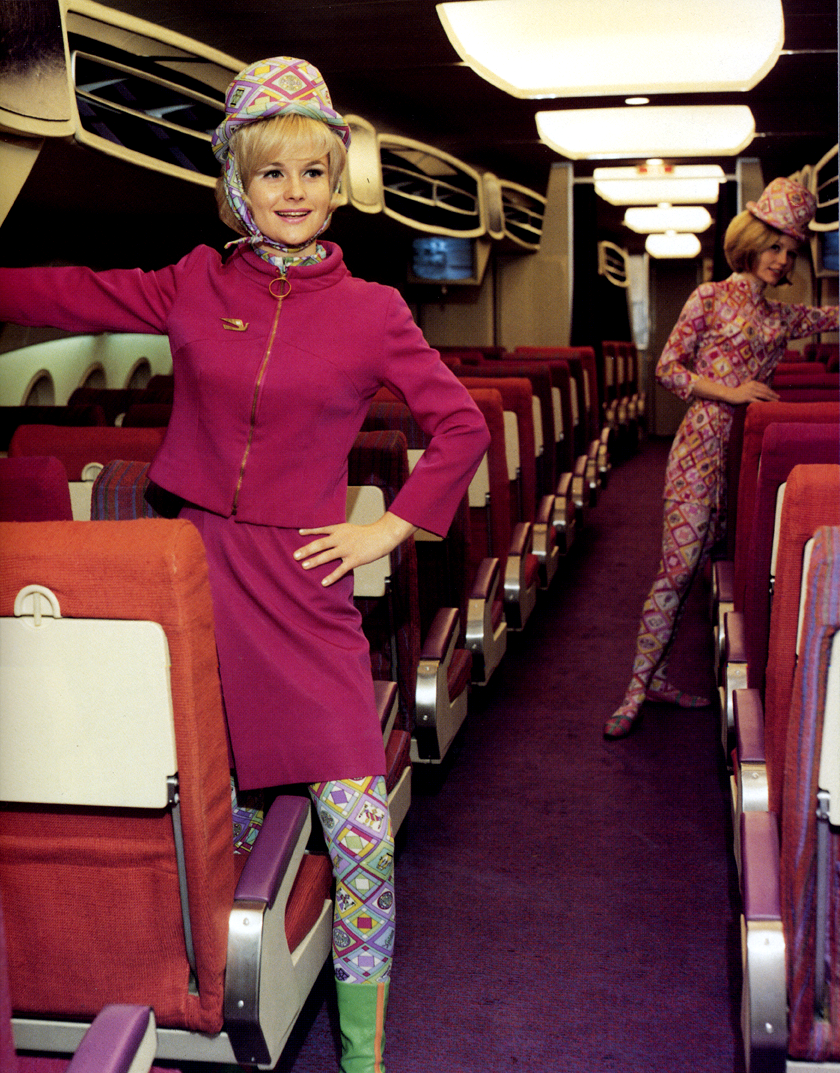
Stewardesses pose in a mod mauve interior, 1965.

Braniff International Airways
was founded in 1928 by brothers Thomas E. Braniff and Paul Revere Braniff.

In 1964, the poorly-managed airline was bought over by insurance tycoon Troy Post. Under the direction of advertising executive Mary Wells of Jack Tinker Associates, a massive overhaul of the Braniff image was launched in 1965: a campaign known as "The End of the Plain Plane". New Mexico architect Alexander Girard and Italian fashion designer Emilio Pucci were among those recruited for this project.

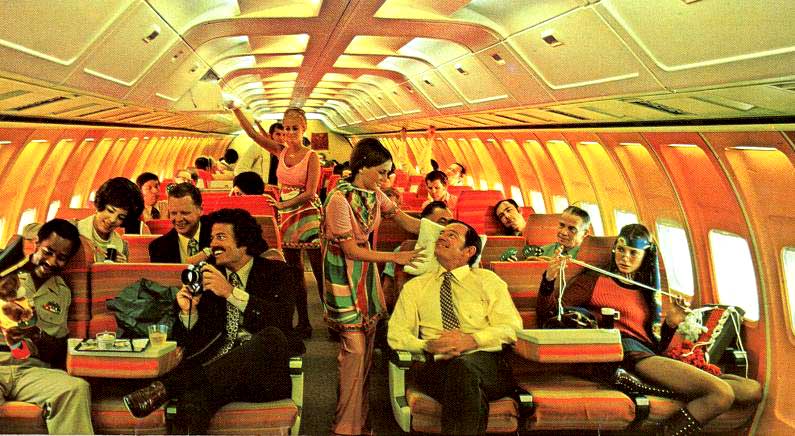
First on the agenda was to overhaul Braniff's public image, which included changing the staid red, white, and blue color scheme to a wide palette of bright hues. A new jelly bean fleet consisted of bold colors such as ochre, orange, turquoise, baby blue, lemon yellow and lavender; with white wings and tails. (Interesting to note is that lavender was dropped after one month as it is considered bad luck in Mexico.)

Wild colors were also applied to aircraft interiors, gate lounges, ticket offices, and even the corporate headquarters. Art to complement the color schemes was flown in from Mexico, Latin America, and South America.

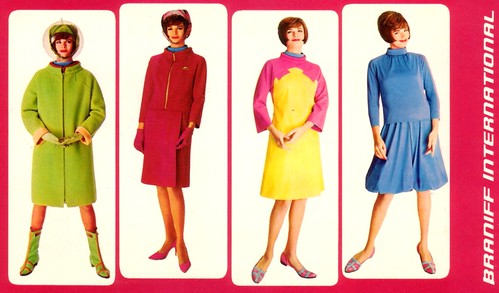
For the crew's uniforms, Emilio Pucci used nautical themes, while the stewardesses were outfitted in "space age" themes. The latter included clear plastic bubble helmets (to protect coiffures) and uniforms with interchangeable parts that could be removed and added as needed.

Today, the vintage Pucci attire designed for Braniff is highly valuable...

747 Braniff Place on her home turf... Dallas, Texas.

Stewardesses in Pucci's 1969 uniforms, in a groovy orange interior.

Fort Worth room at Dallas Love Field, 1968.

This meal is actually an example of the coach class! How times have changed!

Emilio Pucci's space age designs for Braniff stewardesses, 1965.


images: (1) worldofkane.blogspot.com
(2) braniffpages.com
(3) oobject.com
(4) unknown source
(5) braniffpages.com
(6) unknown source

Wednesday, October 18, 2006

The Expo-Express

With a forecast of 30 million visits (which was to become a reality of over 50 million visits), Expo 67 needed efficient on-site transportation.

While the Minirail gave visitors a slower, panoramic view of Expo, the Expo-Express quickly moved large crowds to the different exhibition areas. There were 4 Expo-Express stations: Cité du Havre, Île Sainte-Hélène, Île Notre-Dame, and La Ronde.

Unlike the Metro which ran entirely underground using rubber-tire technology, the Expo-Express operated above ground and on steel wheels. The train's route was 5.7 kilometres long, and waiting time was 5 minutes on average. There were 48 cars in total, 8 sets of 6 cars each. Each train had a capacity of 1000 passengers.

The Expo-Express was the first fully automated transit system in North America. To ease the fears of certain passengers that would not want to embark on a driverless train, personnel was hired and outfitted in nice uniforms, to sit in the front cabin and do nothing at all...!

images: (1) alamedainfo.com
(2) emdx.org

(3-4) library and archives Canada

Saturday, October 14, 2006

The Montreal Metro

The Montreal Metro system was officially inaugurated exactly 40 years ago today, on October 14th, 1966. It is on this day that Montreal became the 8th city in North America and the 26th in the world to have an underground transportation system.

The original Metro system had only 26 stations on 3 lines. Construction began in 1962 with the Green and Orange lines ready in 1966. The Yellow line, which brought passengers to Expo 67, was inaugurated on March 31, 1967, just before Expo opened.

The Metro was the most popular mode of transportation to Expo 67, and more visitors passed through the Île Sainte-Hélène metro station than the "official" main gate of Expo, Place d'Acceuil. Originally, there were plans for an Île Notre-Dame station, on Expo's other island, but the idea was abandoned due to technical difficulties.

The Île Sainte-Hélène station was originally equipped with washrooms and water fountains for Expo. The crowds were so dense during Expo 67 that, occasionally, the train was unable to stop at Île Sainte-Hélène, letting passengers off at Longueuil instead!

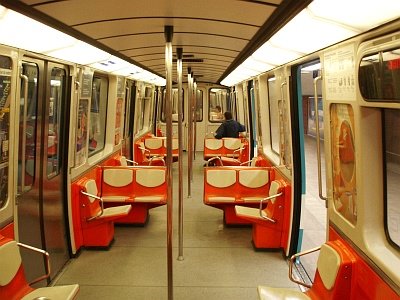
Our Metro has some differences to other subway lines in major cities. First, the Montreal subway runs on rubber tires instead of steel wheels. This necessitated the system to run entirely underground, due to the incompatibility of 1960's rubber tire technology with the harsh Montreal winters. Second, there is no air conditioning in the Metro, which can make summer travelling almost unbearable. And lastly, the metro system is not wheelchair accesible, which is a sore spot for accesibility advocates.

Montreal's Metro is renowned for it's architecture and public art. Mayor Jean Drapeau held design competitions for each station, ensuring that they all had a different look and feel.

The artwork featured in early stations were sponsored by patrons, while subsequent stations included art in their initial budgets. Artists worked in close collaboration with the architects of the stations to create a one of the most unique and beautiful subway systems of the world.

Since 1966, the Metro has carried over 6 billion passengers, which is equivalent to the world's population. Happy Birthday, Metro!

images: (1) internet.uqam.ca
(2) stm.info (3) wikipedia.org
(4-5-6) mic-ro.com

Monday, May 22, 2006

Minirail '67

When I imagine myself visiting Expo 67 (and you know I do), I always imagine myself riding around on the Minirail.

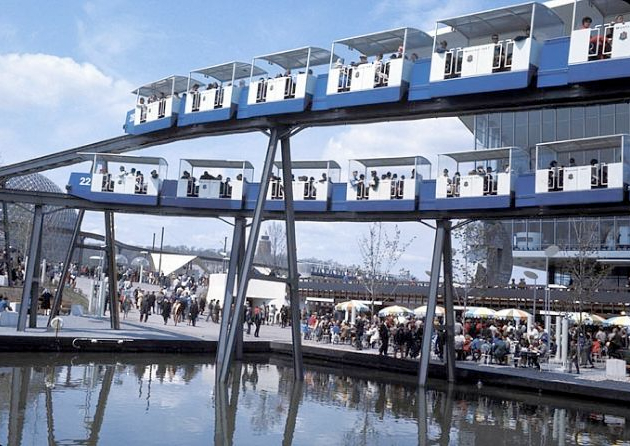
The "Minirail" was a system of small trains that circled Expo on an elevated track. There were 2 types of trains: the blue line Monorail, with larger cars and a more extensive route, and the yellow line Minirail.

Not intended to be a fast and efficient mode of transport, the Minirail offered a slow, panoramic view of Expo. It rode over water, under waterfalls, even through the U.S. geodesic dome!

La Ronde, the amusement park from Expo 67, is still in operation today, as is it's yellow line Minirail. I go to La Ronde every year, and it's become my ritual to first tour the entire park by Minirail before going on any other rides.

On uncrowded days, I stay on the Minirail for 2 to 3 turns. I always sit near the end of the train, facing forward, to get a good view of the train itself, as well as the site... I sit back and imagine myself at Expo 67...

To see the La Ronde Minirail today click here.


images: (1 and 3) library and archives Canada
(2) Bill Dutfield