Thursday, August 17, 2006

La Ronde

La Ronde was one of the most popular sections of Expo 67, attracting 22.5 million visitors in 1967. Though Expo 67 was designed to be dismantled at the end of it's 6-month run, La Ronde had been intended as a permanent Montreal attraction that would last beyond Expo. Indeed, La Ronde has been thrilling visitors for almost 40 years now...

Popular sections of the park included Fort Edmonton, an "old West" town sponsored by the city of Edmonton. Visitors could have their hair cut, have their picture taken behind bars, or relax and have a drink at the Golden Garter Saloon. It was in this section that the popular log flume ride, La Pitoune, was found. The aquatic roller coaster still exists today, one of the most popular of La Ronde. An estimated 20 million people have been on it since 1967!

La Ronde had an impressive collection of the latest in amusement park rides, the star attraction being the Gyrotron. The Gyrotron was a huge pyramid of metal scaffolding, reminding me of the exterior of the U.S. or the Netherlands pavilions. The ride promised to be a thrilling adventure first through space and then down to the core of the earth. Unfortunately, the ride had to be slowed down due to safety concerns, and was a little less thrilling than promised...

La Ronde's cable car system, called the Sky Ride, offered visitors a convenient means of crossing the park. A cable car station was intentionally located near the entrance of La Ronde, to help disperse the thick crowds. The ride has been dismantled in recent years, but I remember riding on it as a kid when visiting La Ronde. It was one of my favorite rides, offering a magnificent view of the park.
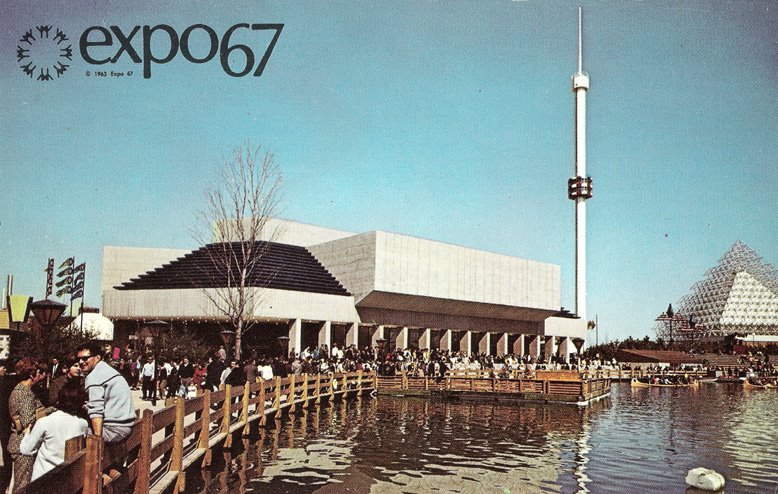
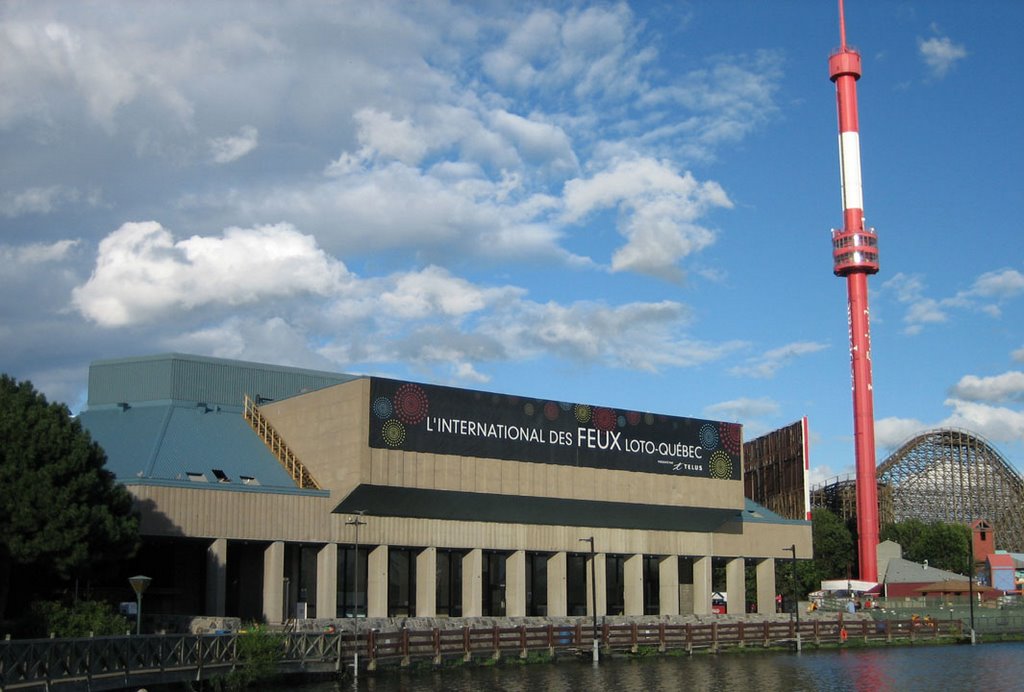
The Garden of Stars was a 1500 seat theatre that held teen-age activities during the day, and Las Vegas-like revues at night. The building still exists today and even the interior (complete with cheesy brown and orange carpeting) has been mostly unchanged since Expo 67...

A Children's World section, devoted to kids aged 4 to 9 years, offered rides inspired by the "Tales of Mother Goose". Three of the original rides are still in operation: a miniature roller coaster, a water journey in a tub, and an old-time train ride.

The La Ronde theme park is the only part of Expo 67 in existance today that still serves it's original purpose. I go every summer, and imagine myself visiting Expo 67...

To see photos of my trip to La Ronde on August 15, 2006, click here.

images: from top: (1) author's own, (2) FOS productions,
(3) alamedainfo.com (4) naid.sppsr.ucla
(5) alamedainfo.com (6) author's own
(7) FOS productions (8) alamedainfo.com

Saturday, August 12, 2006

The 1959 Cadillac

I just got a car, and although I love it, a 2003 Mazda Protegé 5 is not exactly the stuff of retro blog posts...

The 1959 Cadillac, however, is about as retro as you can get! Perhaps the most famous car design in automotive history, the 1959 Cadillacs hold an important place in modern popular culture. They are about as apple pie as Marilyn Monroe or Elvis Presley.

In the 1950's, Cadillac was the undisputed leader in automobile design. During that decade, the North American economy was bouncing back from the Great Depression and World War II. Optimism reigned as America entered the Space Age, and suddenly luxury and splendor were back in vogue. No longer just for transportation, cars and their designs displayed a growing attention to style.

These lavish designs reached their peak with the 1959 Cadillac. The most famous feature of this car was the extravagant 12-inch fins with rocket tail lights. Cadillac ads at the time featured these prominently...

As a kid, I was always fascinated by these beautiful cars, and I've always dreamt of owning one someday...

images: (top) plan59.com
(bottom) 1959cadillac.com

The Cuban Pavilion

Cuba's pavilion at Expo 67 had a modern, cubist look, evocative of a Mondrian painting. The look of the 3-storey pavilion was a result of it's economical assembly: white boxes were pre-fabricated in Cuba and installed on the Expo site.

Like the Indians of Canada pavilion, Cuba's presentation was controversial. Under the theme Revolution, the pro-Castro exhibit was frankly propagandistic. The designers of the pavilion relied on strong photographic images which spilled onto the floors and ceilings for maximum impact. These huge black and white images depicted violence, oppression and revolution.

There were not many captions to these photos, so visitors had to rely on explanatons from the pavilion's hostesses, who referred to Castro as "Fidel", as if he were an adored older brother.

Fishbowl windows in colors of red, blue and yellow distorted the view of the outside world, heightening the intense atmosphere of the exhibit. On the top floor, a wordless film comprised of newsreel footage was presented. The screens which formed the walls of this section were transparent so that at night, passers-by could look up and see the flickering images projected.

Cuban delicacies and rum were served in the pavilion's bar and restaurant.

photos: naid.sppsr.ucla.edu/expo67/

Sunday, August 6, 2006

Mary Tyler Moore

Speaking of women's liberation...

The Mary Tyler Moore show debuted in September 1970, and ran for 7 years. Audiences immediately fell under the spell of the beautiful Mary Richards, a sweet yet vulnerable young woman who moved to Minneapolis after a failed relationship. Although not the first show to feature a young, single female lead, it is the most highly acclaimed and beloved of that genre.

Mary Tyler Moore's character, Mary Richards, was initially supposed to be a divorcée. Producers were worried that audiences would think she divorced Rob Petrie, her onscreen husband during the Dick Van Dyke Show, which had ended only 4 years prior. It was then decided that her character had moved to Minneapolis after a broken engagement.


Screen captures from the first season, where Mary wore a wig.

Producers were also concerned about visual differentiation of those two characters. Seeing as Mary Tyler Moore's hairstyle had remained essentially the same since The Dick Van Dyke Show, she wore a long flip wig during the first season of The Mary Tyler Moore Show.

That wig must have been hell-on-earth for Mary under those hot studio lights, but I love the way it looked! I prefer it to her natural hair...!

One of the best moments of The Mary Tyler Moore Show (and one of the greatest moments in television history, for that matter) was the opening theme, where Mary tosses her hat as a sign of independance.

In 2002, the cable network TV Land had a statue made to commemorate that moment. It stands in downtown Minneapolis, in front of Macy's department store.

Included below is the opening sequence... Enjoy!

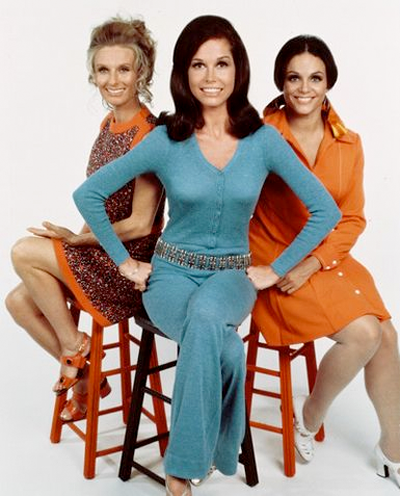
With sidekicks Phyllis (Cloris Leachman, left) and Rhoda (Valerie Harper, right).


images: (1) allaboutjazz.com

(2-3-5) flickr.com
(4) wikipedia.org

Friday, August 4, 2006

Woman and Her World

Expo 67 was a very modern event. Some of the concepts presented at Expo are as valid today as they were in 1967. But once in a while, I'll come across a document that (painfully) reminds me that Expo 67 took place almost 40 years ago (and, might I add, before women's liberation...)

Such is the case for a pamphlet I found a few years ago at an antique dealer. I suspect it was given out at the Hospitality pavilion, a pavilion sponsored by 4 Canadian natural gas companies, dedicated to women. The pamphlet proudly states Woman and Her World at Expo 67, in pink and purple with a floral motif...

The first paragraph of the pamphlet states "if you are a man, read no further!" It goes on to say that although Expo's general theme is Man and His World, it's a woman's world, too! But what this document deems as important to a "woman's world" is amusingly archaic by today's standards...

What are some of the exciting activities mentioned for women? Fashion shows. Pageants. Historical doll exhibits. Handicraft displays. And the special services offered specifically to women? Babysitting...

The best part of this pamphlet is the section on What to Wear to Expo 67. It suggests wearing "a basic print dress that will stay wrinkle-free and can be accesorized for evening wear" because pants "would mean changing every time your husband took you out to the many evening attractions"...(!)

The pamphlet strongly suggests picking up Singer's Sew-it-Yourself Wardrobe for Expo, yet another useful pamphlet that gave detailed costs, fabric suggestions and important tips on sewing your own clothes for Expo!

So that every woman could be beautiful and elegant at Expo 67...

images: personal collection

Thursday, August 3, 2006

Impressions of Expo 67

This movie was produced in 1967 by the National Film Board of Canada.


In my opinion, it is one of the best video documents of Expo. It is only 8 minutes long, but it really captures the mood of this great event...

Tuesday, August 1, 2006

Air Canada Pavilion

The architecture of Air Canada's participation at Expo 67 was intended to evoke the spirit of flight.

The focal point of the pavilion's exterior was a helical roof with 23 blades that fanned out from a 60-foot central column.

The design was meant to represent the turbine of a modern jet engine, yet it has always reminded me of a Leonardo Da Vinci sketch...


Beneath the roof, 3 cylindrical buildings contained the exhibition areas:

The Dream dealt with the man's subconscious desire to fly throughout history.

The Achievement spoke of man's conquest of the sky from early balloons and gliders to modern jet planes.

New Worlds illustrated the impact of aviation on Man and His World.


images: (top) alamedainfo.com
(bottom) naid.sppsr.ucla.edu/expo67/